
Best insulated roof hatch for energy-efficient buildings
With the RHTEP roof hatch, Gorter introduces a new generation of extremely well-insulated roof hatches. The complete construction achieves a Uw ≤ 0.198 W/(m²·K), making it a perfect fit for passive house concepts and sustainable construction projects. Ideal in a market where energy savings and certifications such as BREEAM and LEED are becoming increasingly important.
Fully thermally broken construction
The fully thermally broken roof hatch construction prevents thermal bridges and condensation. In combination with 140 mm insulation, this ensures a comfortable indoor climate and excellent energy performance.
Roof hatch with CE, ETA-18/0287
The RHTEP roof hatch is provided with a European Technical Assessment (ETA), which independently substantiates its performance and CE marking. This is unique within the roof access segment.

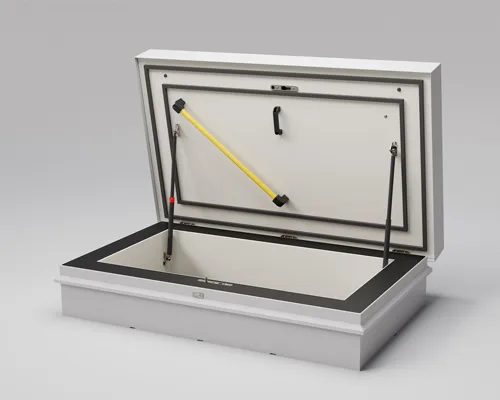



A roof is only as good as its insulation value
With a Uw ≤ 0,198 W/(m².K), the insulation value is unprecedentedly close to the insulation value of modern flat roofs. This is unique within the roof hatch product group, where several products by competitors result in the formation of condensation, energy loss, and even icing, partly due to the lack of a thermally separated construction. At Gorter, we are very well aware that the roof hatch is an integral component of many roofs, so it has to contribute to the total insulation.
The total insulation value is important
Increasingly stricter requirements are being set for the insulation value and energy performance of buildings. The insulation of the flat roof itself also plays an important role in this. The total insulation value of the roof is not just determined by the construction and the roofing plates, but also by its components, such as hatches, drains, grates, and skylights.
For roof hatches as well, communication often takes place with the insulation value of a subcomponent, for example the insulation material. However, due to the absence of, for example, a thermal separation, the entire roof hatch construction can have a different and often lower insulation value.
“It’s about the total insulation value; at Gorter, the insulation value Uw ≤ 0,198 W/(m².K) has been determined for the entire roof hatch construction”.


Calculation of the insulation value of the entire roof hatch construction
While many suppliers only communicate the insulation value of the insulating materials, Gorter has had the insulation value of the entire roof hatch construction calculated. After all, insulation is determined by all the components and not one individual element. With the entirely thermally separated construction, we can confidently say that our insulation value is the actual insulation value.
Analysis in accordance with ISO 10077-1 and ISO 10077-2
The thermal performance has been officially recorded by the engineering firm, Eurosolid. The numerical analysis was carried out in accordance with ISO 10077-1 and ISO 10077-2, from which the insulation value for the smallest roof hatch RHTEP7014 was determined from the FE analysis. Because the critical components in larger roof hatches comparatively have less of an effect on the total insulation value, the hatches have an even better insulation value.

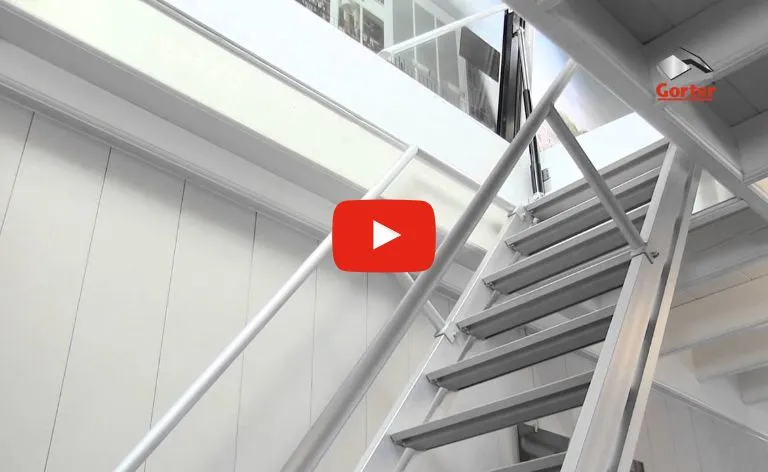
Combine the roof hatch with a ladder, scissor stairs, or a permanent staircase
A total solution for your roof access. Gorter roof hatches can be supplied in combination with a suitable ladder, scissor stair or fixed staircase. With this combination, the dimensions are matched perfectly to each other and maximum safety is guaranteed.
Most Gorter combinations are TÜV NORD and ABOMA certified. Using the documents supplied, it is easy to meet any requirements set out in statutory safety regulations, such as the Risk Inventory and Evaluation (RIE).
 YouTube
 Pinterest
 X
X Instagram

